

An interview with Federico Dal Lago, a professional butcher from Arsiero, Vicenza, vice-president of the Italian Association of Artisan Butchers and member of the Italian national butchers’ team in 2008.
Federico is a meat artisan, a professional with a strong sense of family, school, and haute cuisine teachings and respect for traditions, but constantly striving to experiment, to learn by dealing with people. He is considered a tailor of boning by most experts and is a connoisseur of meat and animal welfare on which we focus in this interview.
Federico is a concentration of professionalism, knowledge, energy, and infinite passion for his work and he makes room to offer his experience and his lucid and humble point of view in front of a delicious veg sandwich prepared especially for the editorial staff of Ghisanativa.
We are in his kitchen in a small place in the foothills of the Veneto region and all around us are enthusiastic staff and customers. Here we have found a small, happy family, open to discussion.
Federico, what do you mean by “animal welfare culture” and how do you combine this term with your experience as a butcher and cook?
I still value open grazing and the availability of fresh grass. I choose local breeds, which are more resistant but obviously less productive. I don’t work with farmers who raise thousands and thousands of animals that are looked after by a few dozen workers. For me, it is not just a question of profit.
Animals are sentient beings: I believe that if animals are kept well, they will experience fewer negative emotions, stress, and suffering.
When we talk about animal welfare, therefore, I am referring to:
I am in favour of balanced food choices: nowadays we have to reduce the size of farms, the consumption of meat but also review the farming models.
But I obviously believe that meat should not be eliminated from one’s diet.
How does a professional like you go about selecting the raw material? What are the farming methods that favour animal welfare?
The concept of animal welfare starts in the barn in my work. I talk about respect for the animal and the important choices made by my breeders.
The space available to the animals in the shelters must be large and adequate. The animals must be able to move freely in the open air for an adequate period of time throughout the year. The barn must be constantly cleaned, adequately lit and ventilated.
I don’t deal with dead animals. If I buy an animal that has lived well and eaten well, the customer is happy, he doesn’t argue about the price and he will taste the difference!
I have had a relationship with the breeder for a long time, it is a relationship of trust. I meet the farmers I work with every week. I talk to them about how the animals are doing, how they are eating and how they are growing. Nutrition is an important aspect and must be of quality, balanced according to age, function, body development and physiological state.
Besides local meat, I work with meat from all over the world. Working with importers is very different to working with a farmer.
Until a few years ago, animal welfare was reduced to the concept of the wild. Today, and increasingly, we talk about sustainable livestock farming, especially in Italy where the law is strict. For example, did you know that after every animal dies, the vet examines every organ to check that the animal has not been treated with hormones?
The meat – for me – must have intramuscular fat and a small amount of surface fat. I choose the animal directly from the barn without relying on a trader who offers me a “commercial value”.
The animal, precisely because it was chosen from a young age, cannot be ruined by slaughter. I take a few animals to the slaughterhouse every week. The abattoir I use is here, just a few kilometres away from the farm and my shop, and there is no stockpiling of animals. The adrenalin rush of waiting for death creates an overproduction of lactic acid and the resulting damage to the quality of the meat. And I want to avoid this.
Unfortunately, slaughter is the most brutal act that exists, but it is a compulsory step for nutrition. The death process is also an important one that must be done in a dignified manner. In this way, slaughter becomes a ritual, a fundamental moment in the life-death passage.
Another important issue is the raw materials linked to the food the animals eat. The costs of raw materials have changed so much over time. The small farmer is generally not subject to these variables: he uses quality hay and alfalfa and is therefore rewarded by those who buy the meat.
I have noticed that the customer is more and more interested in buying local and especially in learning more about cooking and welfare. That is why I have started to shift my interest from the butcher’s shop to the kitchen. I really hope that when the Covid19 situation dies down, this newfound interest in quality products will not die down with it.
If you were looking for a butcher, what characteristics would make you choose one professional over another?
In Italy, unfortunately, there are no training schools to become butchers, unlike in all European countries. So training and certifications are not applicable parameters for choosing a butcher.
A butcher is chosen by knowledge. First of all, I would disagree that the price makes the quality of a product. However, I believe that food product that is considered “expensive” often corresponds to a high-end product. If we want to defend our wealth, our biodiversity, we must know that the product must be paid for, first and foremost out of respect for the enormous amount of work done by those who do not bow down to the big retailers.
are the basic requirements for choosing a professional in my sector. Asking the butcher and receiving answers with arguments is a prerequisite for choosing one person over another.
I have read that breed influences the main parameters of cattle growth rate, reproductive efficiency, maternal capacity, and the specifications of the final product. Is this right for you? Can we analyse the two topics “breeds” and “nutrition” in more detail?
Yes, of course. Did you know that the most prized breeds are French? France has bet a lot on agriculture and breeding. In Italy, we have a myriad of animal breeds but the state has never supported the spread of breeding as it does in other countries.
Once upon a time, the animal was genetically created to generate milk or work. It has only become the meat animal in the last 50 years.
Unfortunately, however, the industrial approach has transformed animal husbandry into “zootechnics”, that is, the science of exploiting animal production, and the farmer into an “agricultural entrepreneur”, it has transferred the industrial principles of economy of scale and mechanisation to this sector. It has freed farmers and stockbreeders from biological constraints: open grazing and grass have been replaced by soya and maize-based feeds, to be consumed in fixed housing, no longer linked to the passing of the seasons and the availability of fresh grass. Local breeds have been replaced by crosses selected to maximise milk or meat production.
Nutrition is an important aspect of animal welfare and must be based on fresh fodder, hay, and any supplementation with quality cereals and legumes, as locally sourced as possible.
I would also add that, fortunately, antibiotics are absolutely banned in Italy, unlike in many northern and eastern European regions.
Can you tell us about marbling and meat flavour? Are the two concepts directly related? Is it true that an intense marbling corresponds to more expensive and higher quality meat?
Let’s take a step back in time: once upon a time the parameter was the leanness of the meat, today, in my experience, the tenderness of the meat is very much in evidence. In any case, a distinction must be made between:
Theoretically, having marbled meat is equivalent to having tastier meat, but this is only a theory. There are, in fact, extremely marbled meats that don’t taste like anything. The marbling, therefore, cannot be a parameter.
Nowadays, choosing marbled meat means spending more because the perceived quality is high. In order to obtain marbled meat, the animals are fed with a different percentage of maize.
You may have heard of the beef whose breed is called Wagyu and is produced in the Kobe region of Japan. This is cattle whose meat has been profitable since 1985. It is a young calf that is not lean and tends to produce intramuscular fat. Well, the most important stable producing this calf contains a maximum of 80 animals of unconventional welfare. It has taken 30 years of genetics and healthy feeding to obtain this money-making animal.
In the meantime, in Italy, since about 1985 we have changed from a working or dairy cow to a beef animal. In those years we established that fatty meat is bad for you and we wiped out an animal that had some fat. As a result, we started to produce lean meat with a bright red colour until about ten years ago. The trade-off was a loss of flavour but the meat was “tender”!
Ten years ago an American company came along and brought to Italy a device that allows us to cook meat differently on the grill and barbecue. Together with this device, the company in question generated information and culture about food and meat. The meat that this company proposed no longer existed in Italy. This has contributed to the reappraisal of cuts of meat that were not even considered before. Less noble cuts are beginning to be reconsidered, such as flank steak, for example. These cuts are very tasty.
More recently, and with the reappraisal of certain cuts of meat, the subject of “food dissatisfaction” has come back into vogue.
Let’s go back to the question of “how do you get naturally tasty meat”. Well, for roasts and stews, a demi-glace is prepared to enhance the taste of the meat. For grilled meat, you have to choose the right raw material and the right pan to bring to at least 170 degrees for an irresistible Maillard.
What is meat maturation and how important is it?
After slaughtering, meat must be left to rest in appropriate conditions of temperature and humidity to acquire tenderness and develop flavours and aromas. The timing is determined by the characteristics of the animal: breed, age, size, type of feed. Nothing can be left to chance or improvised. This rest period is called maturation.
Maturation is an important process that, if done correctly, determines the taste and flavour of everything the animal has eaten. In Italy, the work of expert artisan butchers is increasingly spreading the use of long maturation meats (over 30 days, but up to 120 days or more). We must take into account that:
95% of customers are not used to intense flavours so maturing should be approached in small doses
All this leads to a high cost of meat and makes niche specialisation an activity only for a few meat artisans.
How important is the technical preparation for making a dish?
There is no such thing as bad meat and there is no such thing as tough meat. There is meat that is cooked in the wrong way.
Technical preparation counts a lot. If we refer to tools that you know well, even Ghisanativa requires experimentation and continuous study.
Let’s take an example: you may have heard that “sealing meat prevents the loss of its juices”. There is nothing more false. Sealing means browning or searing the outer surface of a piece of meat quickly, and then continuing to cook it at lower temperatures, either in a pan or in the oven, or barbecued or in a pot. The idea that sealing produces a crust that somehow manages to keep the meat juices locked in during cooking is a false myth that has long since been disproved but there are still people and professionals who peddle this notion as true. The internal juiciness of the meat only depends on the temperature reached, and not on the supposed external sealing. Unfortunately, I often come up against people who say “it has always been done this way in the kitchen, I have always seen it done this way”. This is worrying because butchery and cooking require continuous training, especially if you are an insider. The reasoning of someone who says “I’ve always smelt this aroma” is different.
Nowadays there are thermometers to check how well food is cooked. They are still used too little. Every food has its own perfect cooking time and this depends on the pot you use, the type of meat and the age of the animal and the type of cooking.
How important is the use of a cooking instrument such as for example, Ghisanativa? Tell us about your experience as a man who loves coals and fire.
You can find everything on the market, you just need to have the will to experiment. I recently discovered Ghisanativa. This tool, as well as allowing the exaltation of flavours in the kitchen, is certainly an interesting way of revisiting barbecue and grilled Veneto cuisine in a modern key.
In the barbecue, smoke is considered a fundamental ingredient because it gives an incredible flavour to food. Ghisanativa is able to enhance meat, vegetables, and even egg with ease both on the fire and on the coals. You just need to practice because it is a technical tool. If the dish is cooked well, I have the feeling of eating things from fifty years ago even using raw materials of average quality. Ghisanativa takes me back to a world of the past, with the rediscovery of flavours that I didn’t think I would find again thanks to a pot or a hotplate.
To cook the steak, after having heated the hotplate to a very high temperature (over 170 degrees), I drip the animal fat into the cast iron and then try to flatten it where it curls up until the steak is cooked through (core temperature of 50 to 58 degrees) and a perfect taste is achieved.
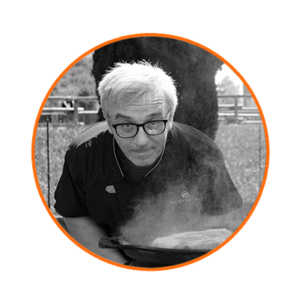
“Federico Dal Lago, a professional butcher from Arsiero, Vicenza, vice-president of the Italian Association of Artisan Butchers and member of the Italian national butchers’ team in 2008.”

