

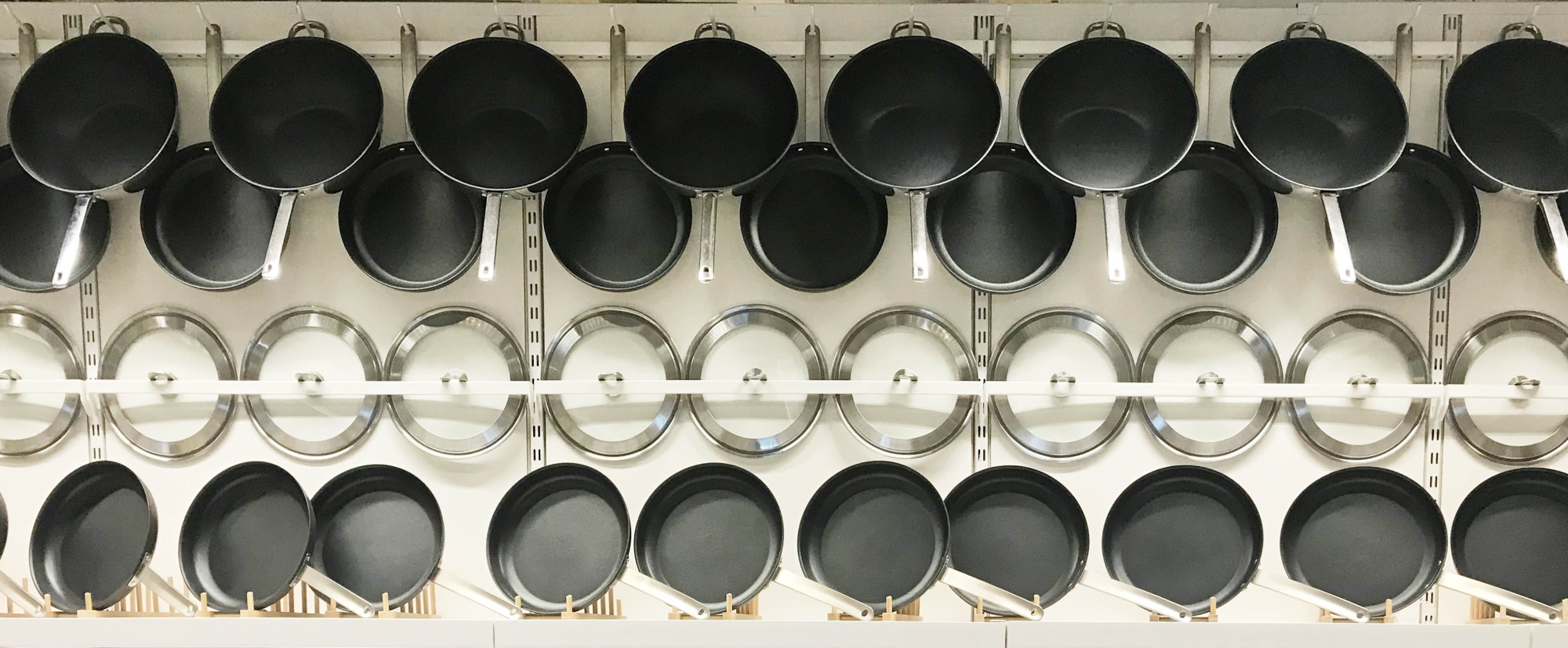
Since the 1960s, pots, and pans with non-stick coatings (the famous Teflon) have been available on the market and have entered most homes. The non-stick coating is usually black and consists of several layers of PTFE covering a metal substrate, often aluminum. The number of layers can vary, as well as the underlying metal, and these two elements determine the quality of the pan.
Polytetrafluoroethylene (PTFE) is originally an odourless, white, light powder that does not dissolve in water or any solvent; discovered by a chemist from the American company DuPont. PTFE was used for years for military purposes and to protect oil platforms so that they would not rust in contact with seawater.
According to some studies, PTFE (polytetrafluoroethylene) used to create non-stick surfaces on frying pans and cookware is toxic and very persistent, both in the body and in the environment.
The American Cancer Society states that polytetrafluoroethylene itself is not carcinogenic and does not cause health risks at the doses with which people normally come into contact.
These are fluorinated chemicals to which fluorine atoms provide low friction and slipperiness that does not allow food to cook properly.
When these coatings reach high temperatures (> 200 degrees) they release PFOA, the perfluorooctanoic acid which has health effects.
PFOA is therefore released when the pan or steak pan sits empty on the cooker for a long time, but also when the surface is scratched either due to use or washing with abrasive sponges.
A recent study by the Nanodiagnostics laboratory in Modena has warned of a different kind of danger. The study focused on the shiny film on non-stick coatings, which would come off and contaminate food, regardless of the level of wear and tear and how the cookware is used.
High levels of PFOA in the blood are linked to an increased risk of developing thyroid diseases, especially in women. This was confirmed by a study by the Environmental Working Group, a US consumer association.
A study carried out by the University of Exeter in the UK came to the same conclusion, showing that women are at greater risk.
The Madrid Declaration, signed in 2015 by more than 200 scientists from 40 countries, lists many of the documented health effects associated with the use of non-stick cookware, including new generation non-stick cookware:
These are just some of the documented effects. Even the stone or ceramic powder coatings commonly used to make non-stick cookware use polytetrafluoroethylene products as binders.
The AIRC (Foundation for Cancer Research) sheds light on the subject in this in-depth article.

