

The first “human” fires date back some 400,000 years. It went something like this. Many trapped animals could not escape the natural fires. They ended up being toasted. And most probably this was one of the steps, one of the stages of our evolution that led us to appreciate cooked meat or rather roasted meat. Perhaps we were first attracted by the smell of smoke! Certainly in the early days … lots of smoke, but not much fire. Some of the burnt plants must have had hallucinogenic and stupefying effects. There are those who maintain that our inclination towards the pleasure of smoking has these ancestral origins; in short, smoking is in our DNA, even if today we are more aware of the effects on human health. But let’s go back to roasted meat, to its aroma, a combination of the smell of wood and animal fat. From a chemical point of view, the exposure of proteins, sugars and fats contained in fresh meat to smoke and fire creates between three and four thousand entirely new chemical compounds, complex and often aromatic molecules. One of the most important of these is named after Louis-Camille-Maillard, the French doctor who identified it in 1912: when amino acids are heated together with sugars, a reaction takes place which produces hundreds of new molecules that give cooked food its characteristic colour and much of its aroma. Think of roasted coffee, bread crust, chocolate, beer… and Chips.
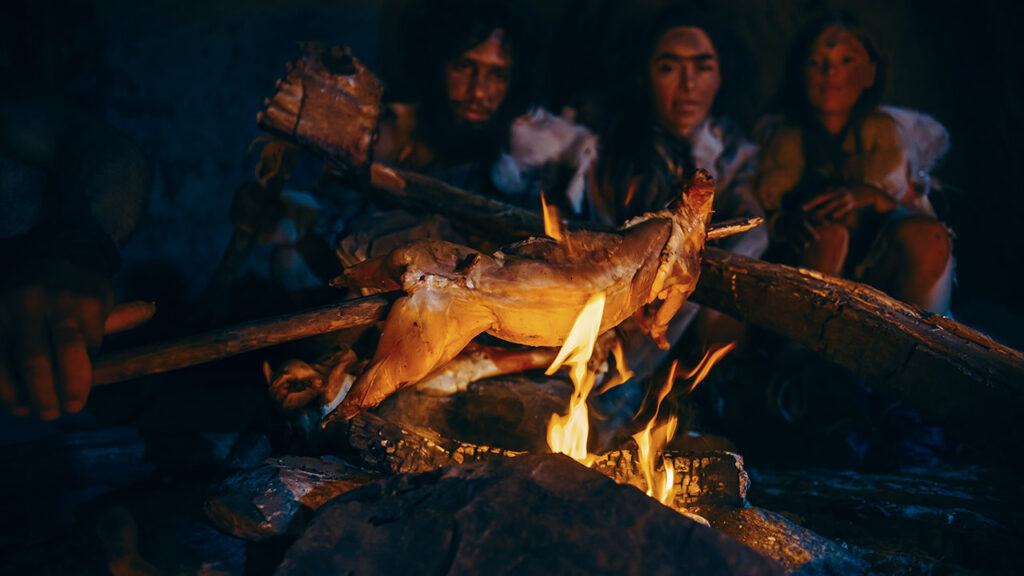
The second reaction leads to caramelisation of the sugars: another hundred or so other compounds, with aroma notes reminiscent of caramel, but also nuts, fruit, alcohol… animal and vegetable together, therefore omnivorous. It is a great and extraordinary encyclopaedia of scents and aromas: how could we resist? What is the monotony of flavours of raw meat in comparison?
Cooking externally performs much of the work that the intestine is supposed to do – it externalises the digestive process – which, in the case of a raw diet, has to break down and dismantle the tough muscle and tendon fibres in the meat and the cellulose in the cell walls of plants in order to absorb the amino acids, lipids and sugars it contains. Starches are gelatinised and proteins denatured. Man has had more palatable food: taste and aroma have improved.
But we did not give up our primitive vegetarianism: we also needed vitamins in their natural state: so we became omnivores and it was a strategic choice for the domination of our species. In addition to taste, cooked meat also has health benefits. Through cooking, parasites and toxic substances are neutralised: we had safer food.

Food historian, writer, guest and consultant of Geo & Geo (Rai Tre)

